CONFERENCES
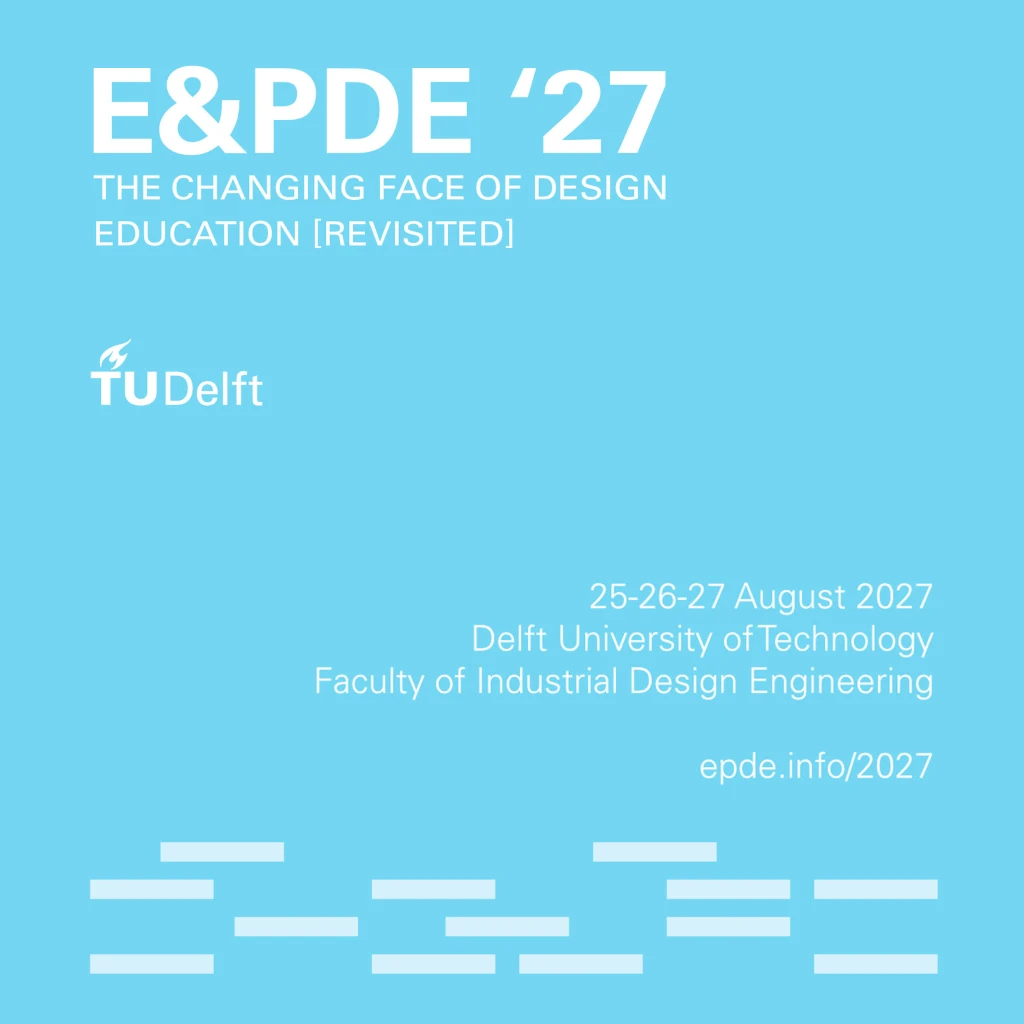
E&PDE 2027 - 29th International Conference on Engineering & Product Design Education
The Conference will bring together representatives from education and industry interested in sharing new perspectives on design education.
Find the Conference, workshop, talk or research school that is just the right fit for you. Find colleagues with shared research interests and invest in yourself.
SSEDR is aimed at PhD students/candidates who are working on topics related to Design Science. The School takes place over 2 separate weeks, this year in Malta (Week 1) and Germany (Week 2).
Week 1: Sunday, 6 June - Saturday, 12 June 2027, Rabat, Malta (connected by bus to the airport)
Week 2: Sunday, 25 July - Saturday, 31 July 2027, Lichtenthal, Germany (connected to Baden-Baden by local bus)
To apply, please fill in the following form by Monday, 1 March 2027: SSEDR'27 Form
The application also requires a maximum 1-page accompanying document including the following:
You will be notified by email about your acceptance by Friday, 19 March 2027. Following acceptance, we will send further details about payment, program details, preparation, travel instructions, server access for file transfers, etc.
The aims of the Summer School on Engineering Design Research are to make PhD students who are working on topics related to Design Science better qualified and equipped for their research by:
The objectives are to provide the participants with:
To achieve these objectives, participants are actively engaged throughout the Summer School, with an emphasis on discussions, exercises and feedback directly based on their own research projects.
Task clarification phase:
First descriptive phase of design research:
Prescriptive phase of design research:
Second descriptive phase:
The research process:
The Summer School is suitable for PhD students who have decided on a research topic, have undertaken a literature study, have formulated first aims and objectives and have an initial plan of work. For a three-year PhD, this will typically be at the end of the first year; for a four- or five-year PhD, at the end of the second year.
Conditions of participation:
In the event of oversubscription, the course organisers will select the participants based on the criteria stated in the prerequisites. In addition, the number of participants from a single research group may be limited.
If you are non-European, please check whether you need a visa for Malta and/or Germany, even if you are doing your PhD in a Schengen country.
The total fee, including full-board accommodation for the two weeks, is 1,700 euros. For members of the Design Society or candidates from institutions with a group membership, the fee is 1,600 euros. Note that an "Associate Membership" in the Design Society is only £20 per year. You can find more information on membership at Design Society Membership.
For both weeks, the fee includes: accommodation (from Sunday to Saturday in both weeks), all meals during the stay from supper on Sunday to breakfast on Saturday, the presentation and background material (both provided via Dropbox), and the book "DRM, a Design Research Methodology". Only the costs of travelling, insurance and visa are not included.
The Design Society will process the payment (credit card or bank transfer) after the acceptance email has been received. Detailed information about payment and the technicalities for uploading and downloading material will be shared with accepted participants in due course.
All participants will receive a certificate of attendance issued by the Design Society and signed by the President of the Design Society and the teachers of the Summer School.
The course spans for two full weeks and involves an estimated 110 hours in total. Whether and how many ECTS credits are recognised depends on each participant's university and PhD program.
We will provide scholarships to partially cover the SSEDR registration fees for participants doing their PhD in a low-, lower-middle- or upper-middle-income countries based on the World Bank country classification by income level:
The scholarships are subject to available funds and fulfilment of the prerequisites to join the SSEDR. The scholarships do NOT cover transportation costs, which must be covered by the participants.
Prof. Dr.-Ing. Lucienne Blessing, lucienneblessing@gmail.com
Independent Scholar, Former Professor at Singapore University of Technology and Design
Prof. Dr. Gaetano Cascini, gaetano.cascini@polimi.it
Politecnico di Milano, Italy, Department of Mechanical Engineering
Assist. Prof. Dr. Tomislav Martinec, tomislav.martinec@fsb.unizg.hr
University of Zagreb, Croatia, Faculty of Mechanical Engineering and Naval Architecture