SSEDR'26 - Croatia & Italy
The 27th Summer School on Engineering Design Research
Week 1: Sunday, 28 June - Saturday, 04 July 2026, Samobor, Croatia (approx. 40 min from Zagreb with public transportation)
Week 2: Sunday, 26 July - Saturday, 01 August 2026, Oropa, Italy (approx. 2.5 hours from Milano or Torino with public transportation)
Application Deadline
To apply, please sign up before Monday, 09 March 2026, by filling in the following form: SSEDR'26 Form
The application also requires a maximum 1-page accompanying document including the following:
- Your research topic (introduction to the problem to be solved, expected outcome)
- The progress you have made thus far (literature study, research questions, approach, etc.)
You will be notified by email about your acceptance by Friday, 03 April 2026. After that, we will send further details about payment, program details, preparation, travel instructions, access to servers for upload and download, etc.
Aims of the Course
The aims of the Summer School on Engineering Design Research are to make PhD students who are working on topics related to Design Science better qualified and equipped for their research by:
- Helping to develop a research approach;
- Encouraging discussion and collaboration;
- Supporting the development of an inquisitive and reflective mindset;
- Fostering a rigorous approach to research.
The objectives are to provide the participants with:
- A research methodology that involves the creation of knowledge and of design support;
- An overview of existing design theories and models to enable the selection of a suitable theoretical foundation;
- An overview of research methods suitable for design research to enable the development of the most appropriate approaches for ones own research;
- An active environment practicing the taught methods using one’s own projects.
- An interactive environment in which individual research topics and exercise results are presented to and discussed with the group and lecturers;
- The opportunity to get to know and learn from other researchers and develop long-term collaborations.
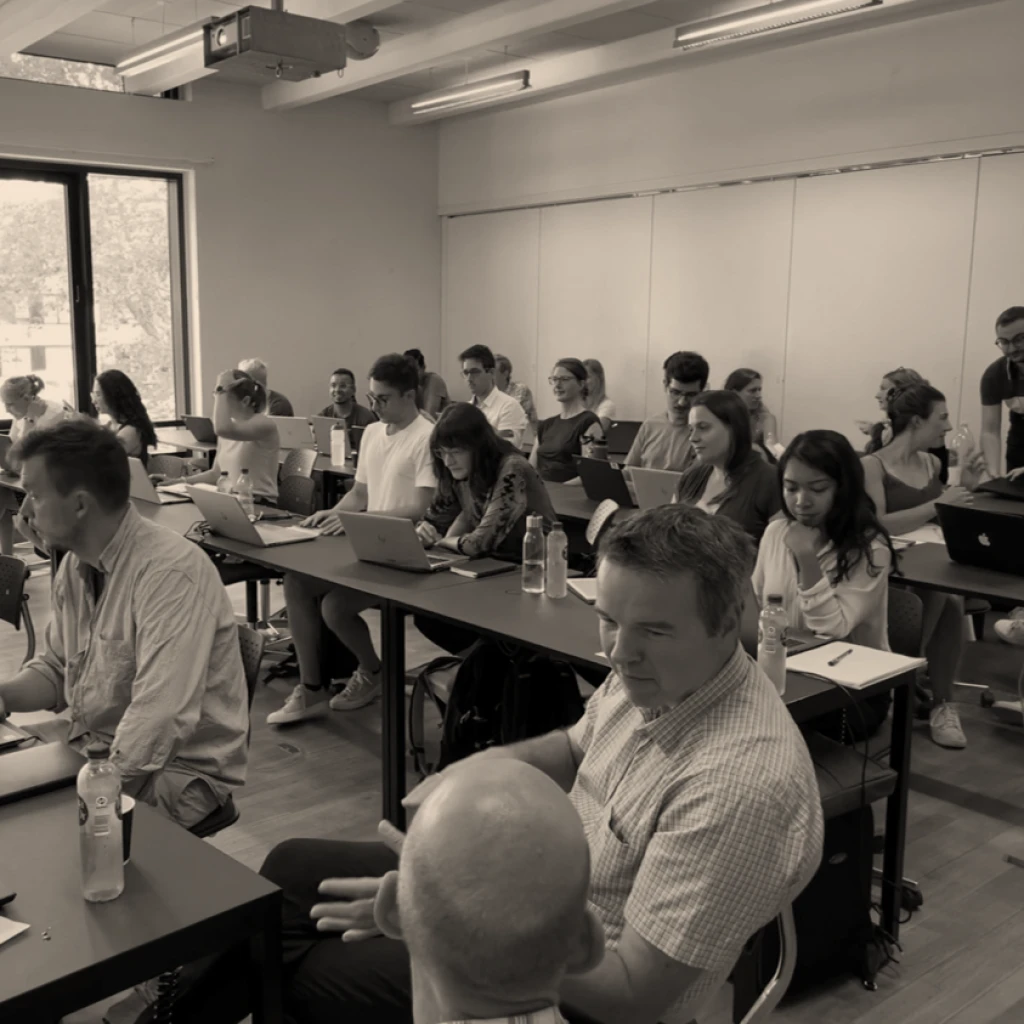
To achieve these objectives, participants are actively engaged in the Summer School: the emphasis is on discussions, exercises and feedback directly based around the research projects of the participants.
Course Topics
- Introduction of participants presenting their projects.
- The nature of design and design research.
- Concepts, models and schools of design and designing.
- The nature and use of theories in design and design research.
- Design Research Methodology (DRM) and examples of its use.
- Task clarification phase:
- Defining the aim, context, and phenomenon of own project;
- Identifying the research gap;
- Formulating research questions/hypotheses for own project;
- Identifying areas of relevance and your own contribution therein;
- Establishing a Reference Model for own project.
- Determining the expected research type of own project.
- First descriptive phase of design research:
- Collecting, analysing and interpretating data, drawing conclusions;
- Identifying suitable data collection methods for own research questions and hypotheses.
- Doing a systematic literature review.
- Prescriptive phase of design research:
- Developing knowledge, methods, models, and tools;
- Identifying scope and assumptions;
- Developing an Impact Model;
- Visualising main research result(s) of own project.
- Second descriptive phase:
- Selecting evaluation methods and approaches;
- Criteria for evaluating support.
- Iterative development of the support;
- Relationships between creativity, research and innovation;
- Research integrity: ethical issues and the trustworthiness of re¬search and research articles;
- Writing a thesis or other publications;
- Reviewing articles;
- Designing a poster for own project and feedback;
- Planning your PhD and publishing your research;
- Your life during and after the PhD.
Pre-requisites
The Summer School is suitable for PhD students who have decided on a research topic, have undertaken a literature study, have formulated first aims and objectives and have an initial plan of work. For a three-year PhD, this will typically be at the end of the first year, for a four- or five-year PhD, at the end of the second year.
Conditions of participation:
- The course language is English.
- The number of participants is limited to max. 20. Therefore, you have to apply for participation.
- Participants have to agree to attend both weeks and all sessions.
- Participants are expected to do the requested homework before the first week and between the first and second weeks.
In case of over-subscription, the course organisers will select the participants, based on the criteria stated in the pre-requisites. In addition, the number of participants in a single research group may be limited.
If you are non-European, please check whether you need a visa for Croatia and/or Italy, even if you are doing your PhD in a Schengen country.
Course Fee
The total fee, including full-board accommodation for the two weeks, is 1,600 Euros. For members of the Design Society or candidates of institutes with a group membership, the fee is 1,500 Euros. Note that an "Associate Membership" in the Design Society is only 20 £/year. You can find more info on membership at Design Society Membership.
The fee includes for both weeks: accommodation (from Sunday to Saturday in both weeks), all meals during the stay from supper on Sunday to breakfast on Saturday, the presentation and background material (both provided via Dropbox), and the book "DRM, a Design Research Methodology". Only the costs of travelling, insurance and visa are not included.
The Design Society will process the payment (credit card or bank transfer) after the acceptance mail has been received. Detailed information about payment and the technicalities for uploading and downloading material will be shared in due time with the accepted participants.
Participation Certificate
All participants will receive a certificate of attendance issued by the Design Society and signed by the four teachers of the Summer School.
The course accounts for two full weeks and involves an estimated 110 hours in total. Whether and how many ECTS are recognised depends on each participant's university and PhD program.
Scholarships
In 2026, we will provide scholarships to partially cover the SSEDR registration fees for participants doing their PhD in a low, lower-middle or upper-middle countries based on the World Bank country classification by income level:
- Low-income countries: 100% scholarship
- Lower Middle Income countries: 75% scholarship
- Upper Middle Income countries: 50% scholarship
The scholarships are subject to the available funds and fulfilment of the pre-requisitesto join the SSEDR. The scholarships do NOT cover transportation costs, which must be covered by the participants.
Contact - Teaching Staff
Prof. Dr.-Ing. Lucienne Blessing, lucienneblessing@gmail.com
Independent Scholar
Prof. Dr. Gaetano Cascini, gaetano.cascini@polimi.it
Politecnico di Milano, Italy, Department of Mechanical Engineering
Prof. Dr. Daniela Pigosso, danpi@dtu.dk
Technical University of Denmark (DTU), Dep. of Civil and Mechanical Engineering
Assist. Prof. Dr. Tomislav Martinec, tomislav.martinec@fsb.unizg.hr
University of Zagreb, Croatia, Faculty of Mechanical Engineering and Naval Architecture