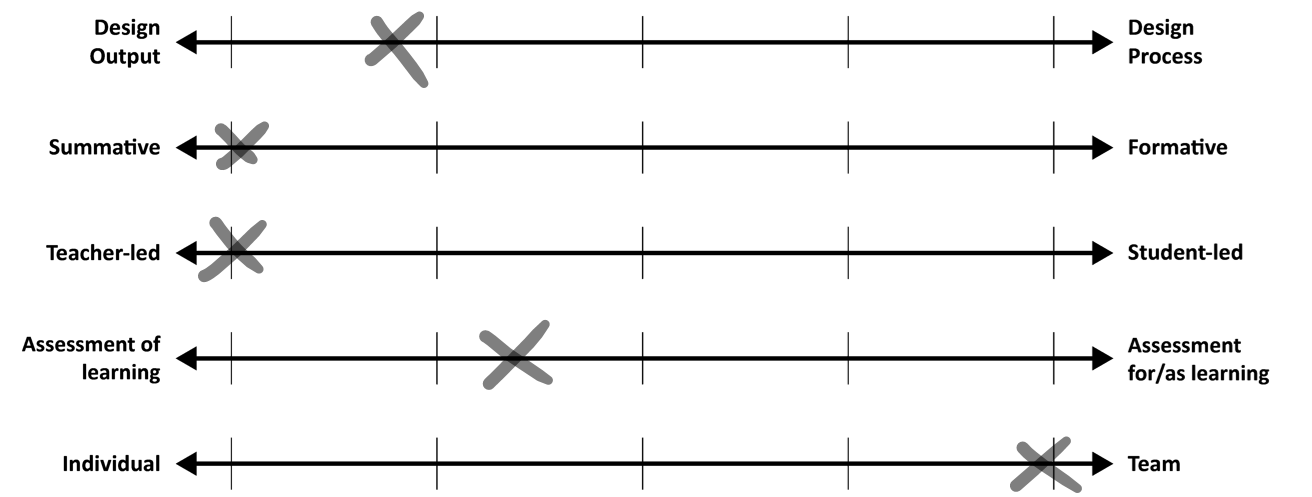
How do we ensure that assessment in project-based design education values not only the final outcome, but also the learning, decision-making and collaboration that occur along the way? Developed by Elies Dekoninck, Ross Brisco, Francesca Mattioli, Erik Bohemia, Yakhoub Ndiaye, Hilary Grierson and Gordon Krauss, of the Design Society Design Education Special Interest Group, the Design Learning Assessment Dimensions (D-LAD) Framework was created to help educators explore this question and make assessment practice more visible, balanced and intentional.
The framework identifies five key dimensions that shape assessment in project-based learning: Output versus Process, Summative versus Formative, Teacher-led versus Student-led, Assessment of Learning versus Assessment for/as Learning, and Individual versus Team Assessment. Together, these dimensions provide a shared language for reviewing, discussing and redesigning assessment strategies to better align with intended learning outcomes, industry expectations and accreditation requirements.
Emerging from a programme of literature review, educator consultation and international workshops, D-LAD offers a practical tool for educators seeking to reflect upon existing assessment practices and explore alternative approaches. Whether used to review a single module or map assessment across an entire programme, the framework encourages thoughtful discussions about what is being assessed, why it is being assessed, and how assessment can better support student learning and professional development.
The D-LAD framework and how to use it is detailed on the Design Exchange Methods page.