Knowledge Base Repository
In addition to research papers, the Design Society is developing several valuable resources for those interested in the study of design. These include a repository of PhD theses, a library of case studies and transcripts of design activities, and an archive of our newsletters. Please note that these resources are accessible exclusively to Design Society members.

D-LAD: Design Learning Assessment Dimensions
Analyze Time Perspective: Future possibilities, Time Perspective: Present situation
The Design Learning Assessment Dimensions (D-LAD) Framework is intended to support educators in the design, review and refinement of assessment within project-based design education. Rather than prescribing a particular assessment approach, it provides a structured means of examining assessment through five dimensions: output versus process, summative versus formative, teacher-led versus student-led, assessment of learning versus assessment for/as learning, and individual versus team assessment. By making these dimensions explicit, the framework helps educators reflect on the choices they make when designing assessment and consider whether those choices align with intended learning outcomes and educational priorities.
In practice, an educator might begin by mapping an existing module against the five dimensions. This process can reveal whether, for example, assessment is disproportionately focused on final deliverables rather than the design process, whether students receive sufficient formative feedback during projects, or whether individual contributions are adequately recognised within team-based activities. The framework therefore acts as a diagnostic tool, helping educators identify gaps, imbalances and opportunities for improvement within current assessment strategies.
The framework can also be used during the development of new modules or the redesign of existing ones. By considering each dimension explicitly, educators can make intentional decisions about the role of feedback, peer assessment, teamwork and reflective practice within a course. For example, a module team may decide to introduce formative design reviews, peer assessment activities or individual reflective submissions to create a more effective assessment approach.
At a programme level, D-LAD offers a shared language for discussing assessment across multiple modules and years of study. Programme teams can use the framework to map assessment practices across an entire curriculum, helping to ensure students encounter a progressive range of assessment experiences and opportunities for development. The framework may also support conversations with external examiners, accreditation bodies and industry partners by providing a clear rationale for assessment decisions and demonstrating how assessment aligns with professional and educational expectations.
From an educator's perspective, the D-LAD Framework helps make assessment design more deliberate, visible and aligned with learning outcomes. It enables educators to review existing assessment strategies, identify imbalances, and ensure that design knowledge, skills and outputs are appropriately recognised. By encouraging consideration of formative feedback, peer assessment, reflection and evidence of decision-making, D-LAD can support richer learning experiences and a more comprehensive evaluation of student achievement. The framework also promotes fairness and transparency by helping educators balance individual and team contributions and gather evidence throughout a project rather than relying solely on final outputs. In addition, it provides a common language for discussing assessment with colleagues, students, accreditation panels, external examiners and industry partners.
One limitation of D-LAD is that it is a reflective framework rather than a prescriptive method. It helps educators identify and discuss assessment choices but does not provide detailed guidance on how specific assessment challenges should be addressed in practice.
The framework relies on informed professional judgement. Mapping assessments onto the five dimensions involves interpretation, meaning different educators may reach different conclusions. There is also a risk that users may treat the dimensions as a checklist and pursue unnecessary balance across all dimensions, when some modules may legitimately be more summative, output-focused or teacher-led.
In addition, D-LAD currently focuses on five dimensions identified through literature review and educator workshops, meaning it may not capture every factor influencing assessment in project-based learning. Finally, if used without a clear purpose, applying the framework can increase workload through additional reflection, evidence collection and assessment activities. Educators therefore need to use it strategically to ensure changes add genuine educational value.
Effective use of the D-LAD Framework requires educators to possess a combination of curriculum design, assessment and reflective practice skills. Users should understand how learning outcomes, assessment methods and project-based learning activities align. They must have sufficient assessment literacy to interpret concepts such as formative and summative assessment, peer assessment, feedback and teamwork evaluation. The framework also relies on critical reflection, as educators must analyse existing assessment approaches, identify strengths and weaknesses, and consider alternative ways of evidencing student learning.
A D-LAD activity can be completed individually or as a collaborative workshop involving module teams, programme leaders, industry partners or external examiners.
It is important to note that one D-LAD mapping should be completed per assessment. If there are two assessments as part of a module or class, then two separate D-LADs should be completed. Both should be considered together in Step 4 to understand the overall assessment profile.
Step 1: Define the Project or Module
Select the module and assessment that will be reviewed. Gather relevant materials such as module descriptors, assessment briefs, marking criteria, feedback processes and learning outcomes. The goal is to establish a clear picture of the existing assessment approach before beginning the analysis.
Step 2: Introduce the Five D-LAD Dimensions
Ensure participants understand the five dimensions:
- Output ↔ Process
- Summative ↔ Formative
- Teacher-led ↔ Student-led
- Assessment of Learning ↔ Assessment for/as Learning
- Individual ↔ Team Assessment
A description of each of these dimensions is elaborated in D-LAD - A FRAMEWORK FOR PROJECT-BASED DESIGN ASSESSMENT: EDUCATORS’ INSIGHTS.
Discuss what each dimension means in the context of the project or module being considered.
Step 3: Map the Current Assessment
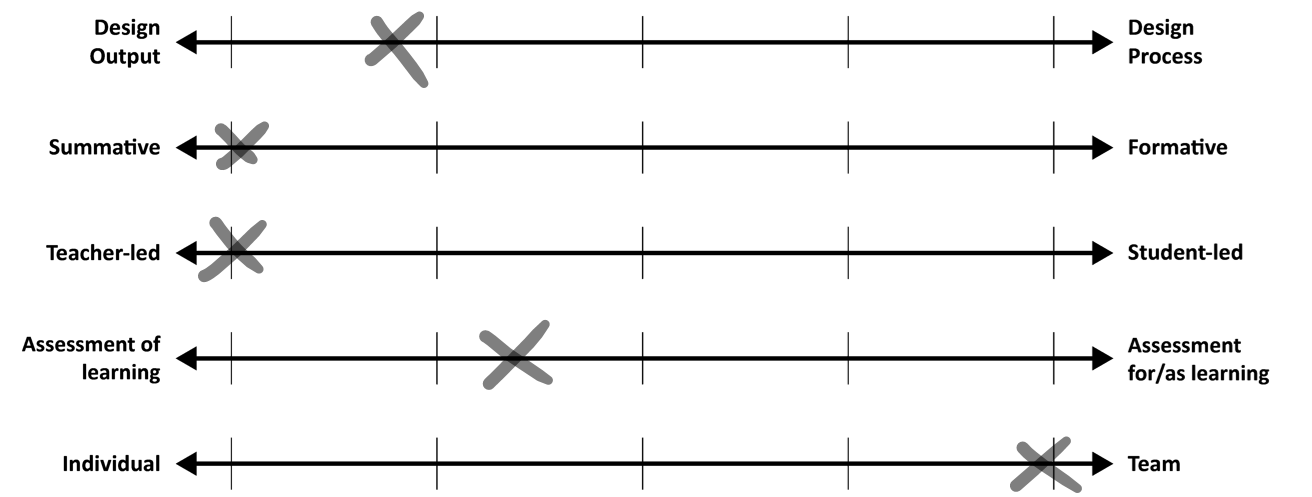
Using the D-LAD framework, plot where the current assessment sits on each dimension. If working as a group, it can be beneficial to plot the assessment individually before sharing views as a group.
For example:
- Final prototype and report assessment may sit towards Output.
- Interim design reviews may sit towards Formative.
- Peer assessment may move assessment towards Student-led.
- Individual reflective logs may sit towards Individual Assessment.
The objective is to create a visual representation of the current assessment profile.
Below is an example of a completed D-LAD mapping for an individual assessment.
Step 4: Discuss the Assessment Profile
Review the completed map and discuss questions such as:
- What is being valued and rewarded?
- Are design processes being assessed sufficiently?
- Do students receive opportunities to learn through assessment?
- Is teamwork recognised appropriately?
- Are there dimensions that are over- or under-emphasised?
This stage often generates valuable conversations about implicit assumptions in assessment design.
Step 5: Identify Desired Learning Outcomes
Return to the intended learning outcomes and ask:
- What knowledge should students develop?
- What design skills should they demonstrate?
- What outputs should they produce?
- What professional behaviours should be encouraged?
Consider whether the existing assessment profile supports these intended outcomes.
Step 6: Redesign the Assessment
If changes are required, create a second D-LAD map representing a revised assessment strategy.
Potential modifications might include:
- Adding formative design reviews.
- Introducing peer or self-assessment.
- Including reflective journals.
- Increasing evidence of design process.
- Rebalancing individual and team marks.
The revised map should better align assessment with the desired educational objectives.
Step 7: Compare Original and Revised Maps
Place the two maps side-by-side and discuss:
- What has changed?
- What new evidence will be collected?
- Are students likely to receive better feedback?
- Does the revised approach improve fairness?
- Are workload implications manageable?
The example presented in the paper compares an existing assessment with a redesigned version incorporating multiple formative milestones and greater emphasis on process evidence.
Step 8: Agree Actions and Implementation
Document any changes to be made, including:
- Assessment components.
- Timing of feedback.
- Marking responsibilities.
- Student guidance.
- Evaluation measures.
Develop an implementation plan for the next delivery of the module or programme.
Step 9: Review After Delivery
Following module delivery, repeat the D-LAD exercise using staff and student feedback. Consider what worked well, where challenges emerged, and whether the assessment profile should be adjusted further. This creates an iterative process of continuous improvement.
In practice, the most valuable output is often not the final map itself, but the discussion it stimulates around what educators truly want students to learn and whether current assessment practices actually support those aims.
For more information on the development of the D-LAD visit: D-LAD - A FRAMEWORK FOR PROJECT-BASED DESIGN ASSESSMENT: EDUCATORS’ INSIGHTS.
The developers of the D-LAD framework have created a guided workshop and worksheet to support assessment reflection. Contact one of the team to learn more about the delivery of this workshop for your institution.
The D-LAD Framework was developed by Elies Dekoninck, Ross Brisco, Francesca Mattioli, Erik Bohemia, Yakhoub Ndiaye, Hilary Grierson and Gordon Krauss through a process of literature review, educator consultation and collaborative workshop activity. The framework emerged as a response to the need for a shared language and structured approach for analysing and improving assessment within project-based design education. The D-LAD Framework was not developed by a single researcher or institution, but through a collaborative, international effort involving expertise from the UK, Italy, China, Norway and USA.
To further verify and validate the framework, the authors facilitated workshop's at the DESIGN 2024, and DESIGN 2026 conferences in Dubrovnik, Croatia, and the E&PDE 2026 conference in Bristol, UK. Participants shared examples from their own teaching practice and generated insights into the tensions that often exist between educational goals, student learning needs, and industry expectations. The outputs from these discussions were subsequently analysed and synthesised by the authors to inform the final structure of the framework.
Dekoninck, E., Brisco, R., Mattioli, F., Bohemia, E., Ndiaye, Y., Grierson, H., & Krauss, G. (2025). D-LAD-a framework for project-based design assessment: educators’ insights. In DS 137: Proceedings of the International Conference on Engineering and Product Design Education (E&PDE 2025) (pp. 577-582).